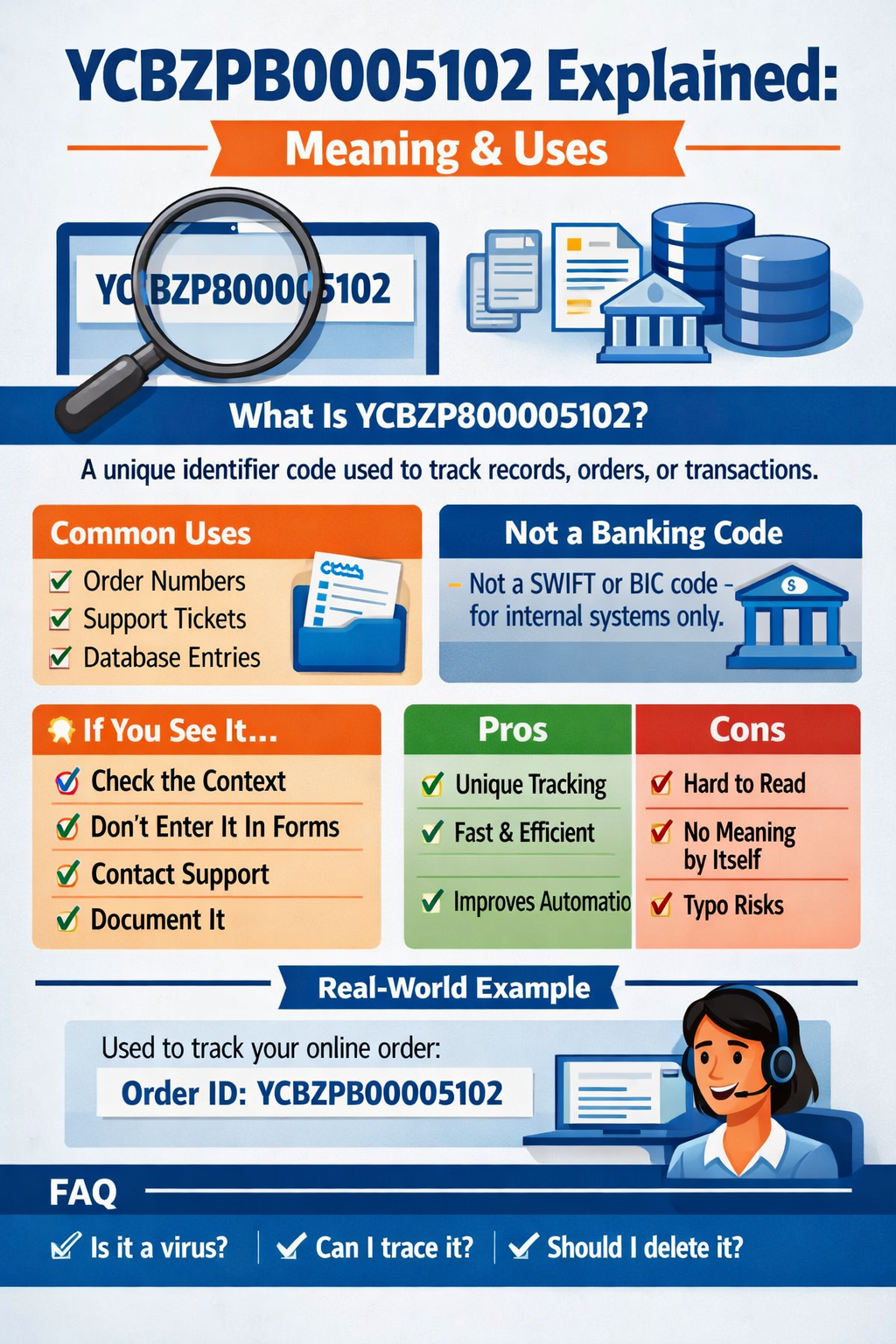
If you’ve stumbled upon the string YCBZPB00005102, you’re not alone. This unusual combination of letters and numbers has sparked curiosity online — but what does it actually mean? Let’s break it down in a clear, beginner-friendly way and explore real-world scenarios where similar identifiers are used.
What Is YCBZPB00005102?
YCBZPB00005102 isn’t a word, brand, or standard acronym. Instead, it looks like a system-generated identifier — a unique alphanumeric label created by digital platforms, databases, or software tools to mark a specific item, record, transaction, or part.
These codes are designed for uniqueness, not readability. They help systems track and reference entries without conflict — especially where millions of records exist.
Why Do Codes Like This Exist?
Here’s why identifiers such as YCBZPB00005102 are common in technology:
- Database tracking: Each entry in a system (like a user, order, or product) needs a unique tag.
- Internal reference: Companies use these codes to help support teams locate information quickly.
- System performance: Short codes enable faster data lookup and reduce storage overhead.
- Security & privacy: The code doesn’t reveal personal data, keeping sensitive info safe.
Put simply, these identifiers function like digital fingerprints — unique and directly tied to one entity or record.
Common Places You Might See It
While the exact source of YCBZPB00005102 isn’t publicly documented, similar codes frequently appear in:
- Order confirmations or shipment tracking systems
- Support ticket or case numbers
- Product part tags or serial labels
- Database records in enterprise software
- Automated system logs or dashboards
In most cases, the code tells the system exactly where to find the information without revealing the details.
Why It’s Not a SWIFT or Banking Code
Some users wonder if YCBZPB00005102 could be a SWIFT/BIC code for bank transfers. It isn’t — international financial codes have strict formats with 8 or 11 characters, made up of specific letter patterns. YCBZPB00005102 doesn’t match this structure.
So, if you’re trying to send money, use the correct SWIFT/BIC provided by your bank instead.
Practical Tips: What to Do If You Encounter It
Seeing this code in your digital workflow can be confusing. Here’s how to handle it safely:
- Check the context: Where did it appear — email, log file, invoice? That clue matters.
- Avoid guessing: Don’t enter unknown codes into payment or login forms.
- Contact support: If the code appeared in a service you use, customer support can identify its origin.
- Document the appearance: Screenshots and timestamps help trace it later.
Generally, the code is harmless on its own — the risk comes from suspicious accompanying content or links.
Pros & Cons of System Identifiers
| Pros | Cons |
|---|---|
| Unique tracking across systems | Hard for humans to interpret |
| Speeds up database operations | No inherent meaning without context |
| Improves automation and analytics | Mistypes can cause errors |
| Helps with auditing and compliance | Can be confusing when unexplained |
Real-World Example
Imagine an online retailer. Every time you place an order, the system assigns a code like YCBZPB00005102 to that order behind the scenes. When you contact support, that code helps agents instantly find your order — even if customer names are similar.
In more technical cases, engineers use similar identifiers to track hardware components or log system events across distributed networks.
Common Mistakes to Avoid
- Assuming it’s dangerous: The code itself isn’t malware — but context matters.
- Sharing sensitive info publicly: Don’t share screenshots that tie the code to personal data.
- Treating it as a step in a procedure: Don’t input it into unrelated forms or requests.
Frequently Asked Questions (FAQ)
Q: Is YCBZPB00005102 a virus or scam?
A: No — by itself, it’s just a code. But caution is warranted if it appears in suspicious messages.
Q: Can I trace it online?
A: Not publicly — only the originating system can interpret it.
Q: Should I delete messages containing it?
A: Only if the message looks suspicious. Otherwise, save it and contact support if needed.
Q: Is it linked to any product?
A: There’s no evidence it’s tied to a publicly sold product or brand.
Q: How can businesses use identifiers like this?
A: For inventory tracking, database record linking, transaction IDs, and system logs.
Conclusion
YCBZPB00005102 is most likely a unique identifier used by systems to track a specific entry, transaction, or record. It doesn’t carry meaning on its own, but it plays a vital role in helping software and databases function efficiently. When you encounter such a code, focus on context and safety — and consult support teams when in doubt.
Whether you’re a beginner or intermediate user in tech or business, understanding these identifiers can reduce confusion and help you navigate digital systems with confidence.

